Welcome to our blog!

Welcome to our blog! Learn about our farm operation, public programs, and the people behind our work through the Notes from the Field and Education sections. Peruse the Recipes section for some staff favorites.

Waltham Fields Community Farm (incorporated as Community Farms Outreach, Inc.) is a nonprofit farming organization focusing on sustainable food production, fresh food assistance, and on-farm education. For more information about Waltham Fields check out our website!

Showing posts with label flowers. Show all posts

Friday, July 29, 2016

Let's All Do A Rain Dance!

As I see it now, the theme of the summer is easily summed up in two words: HOT and DRY.  It literally feels like the dust bowl out there and I can't really remember the last time we had a soaking rain.  The sun felt strong this week and although it's physically challenging work, I feel more connected to our Earth and our food through this challenging weather.  We as farmers spend most of our waking hours absorbed in the same environment as the food we grow and eat.  It feels similar to when you share a meal with someone and you are all eating the same thing.  Knowing that we as a crew and as a community share the same sun rays as the plants, the same temperature, and live on the same soil, keeps me going on those long, hot days.  There is a freedom in simply being in our environment in all weather and letting go of our comfort zones.  This is when I see the most growth and change in my life.      
Our morning routine this week has been to head straight for the water and in every direction possible.  We are using all the tricks we can.  Our aluminum pipe system has taken up residence in our newly planted west field, taking care of our fall brassicas, chard, lettuce, and beets.  This system which delivers the most water through overhead sprinklers requires us to move about 7 long aluminum pipes across the fields.  It feels as though you could pole vault with these - they are much lighter than one would think.  It's quite empowering to carry them on your shoulder and I must say that Erinn and Dan both do it with such grace, each able to carry two pipes at once. 

Second, we have the water reel (not to be confused with the water wheel which is used when transplanting).  This is just a couple years old now and let me tell you, it's a work out setting it up.  It is a retractable hose with a sprinkler attached that covers about 7 beds in either direction depending on the wind.  When Janelle and I pull it out at 7am, we debate over who will get the full body workout and who gets just intense arm strengthening.  It's a great way to wake up in the morning if you ever get a chance to try it.
Yet another way is our drip lines that remain under our biodegradable plastic used with our tomato, eggplant, and onion crops to name a few.  Although this takes more time and possibly more money upfront to lay down on the beds, it is ultimately a more efficient system and requires us only to turn the faucet or pump on for a few hours assuming the pump is working...  It does require time for setup and repairing of holes, but the water goes directly to the roots avoiding the pathways and foliage of the plants.  It also does not compact the soil as much as an overhead sprinkler system. 
Lastly, we are even using your run-of-the-mill home oscillating sprinkler which works great for directly seeded crops like our carrots, but also has saved the flowers which I will
add are STUNNING! Erinn has done an amazing job! With all of these methods of watering we must think strategically in order to be most efficient with our time and energy as well as conserving water where possible - which is what farming is all about.  We need to think about how long the water reel will take to run, which pipes have more pressure, what crops are in dire need, what covers the most amount of space, what will need transplanting next, etc.   

Last week marks the end of an era and the beginning of many others.  Summer education programs started last week and it's refreshing to have so many young people on the farm.  There is so much discovery and exploration happening and it puts a smile on my face.  A couple weeks ago a little girl asked me as I was in the wash station, "Are you a farmer?" and I replied "Yes I am, who are you?" and she proceeded to tell me her name.  It's such a delight to have so many levels of education happening in one place. 


We finished harvesting the garlic which had been in the ground since November, so it felt like a big deal.  This particular garlic really went through the ringer.  It sprouted in December and then we quickly mulched it with leaves.  It definitely experienced some deep frosts and did not receive much water or fertilization.  We didn't even need to weed it all season!  But to both Erinn's and my surprise it is some of the most beautiful garlic we have had in a few years.  The garlic will now cure in our greenhouse for a couple of weeks so that it will be able to store for the winter months.   
As for the summer vegetables, such as tomatoes, eggplants, peppers, and carrots, they are moving along and should be ready very soon.  Luckily for these crops the heat and sunshine is perfect - we just need to keep watering.  The routine continues of seed, transplant, water, weed, water, harvest, and repeat.  And did I say water?      


I will leave you with a quote Amanda shared a few years back at this midsummer time. "The beat of time is like the throb of a healthy heart, strong, steady and reassuring...it is the richness and the ripeness of the earth again made manifest. And man participates, if he will, not as proprietor but as a participant in life itself." -Hal Borland.


Enjoy the summer, the harvest, and the world around us,
Anna Kelchlin
Assistant Farm Manager
for the Farm

Thursday, September 20, 2012

Notes from the Field: Why We Farm Organically

Yardlong beans and morning glories in the Learning Garden

A recent Stanford University study made news by casting doubts upon whether organic food is, simply by being organic, healthier for us than non-organic food.  The news coverage of the story featured many people being surprised about the fact that organic farms do use pesticides and fertilizers (ones that are on a list approved by the Organic Materials Review Institute), and that organic food does not automatically provide more nutrition or health benefits to its consumers.  One radio report hinted at the fact that 'organic' might just be a ploy by some big companies to be able to charge unsuspecting customers more for healthier-sounding food.


B to F: tomatoes, broccoli, and turnips

I've been mulling over what troubles me about this the coverage of this study (actually a meta-study, which examined a large amount of data collected in experiments over the past couple of decades).  I've read Michael Pollan's response, as well as the argument from Marion Nestle (written prior to the Stanford study's publication) about the ongoing controversy over organic food, and I think I've figured out what it is: for many of us who farm organically, who are not associated with big companies or even big agriculture, organic is not just a consumer label.  In many ways, it has very little to do with how we market our products.

PYO husk cherries, also known as groundcherries

Organic farming is about how we grow, why we do what we do, and our desire to make a positive impact on the world.  I chose organic farming as a profession because I believe that organic production is a scientifically based attempt to create an agriculture that produces economically viable yields of beautiful, nutritious vegetables while remaining as beneficial to the environment, and to farmworkers, as possible.  While I often shorten it to "farmer" when I'm describing what I do, in my heart of hearts, I'm an organic farmer.

Okra flower and young pods

To me, organic doesn't mean boutique farming or baby vegetables, or getting the highest price we possibly can for our crops.  The higher price for organic food is only justified because sometimes it costs more money to grow in a way that is more environmentally thoughtful; composted dairy manure, for example, costs more than synthetic petrochemical fertilizers but is less likely to create pollution if it is well-managed.  (In an ideal world, the cows that produce that manure would also live on the organic farm, but our agricultural world, especially in our urban area, is very much less than ideal.)  Organic farming, to me as a grower, means that I can almost always eat what I grow right out of the ground; it means that my children, and our shareholders, and the people who work on the farm day in and day out, can walk through the fields, pick their own food, and generally eat from the land in a way that minimizes the amount of pesticides they are exposed to.  It means making a conscious effort, day in and day out, to farm in a way that builds healthy soil that grows healthy food.

B to F: carrots and bush beans (and some weeds)

Organic farming isn't perfect.  It can be fuel intensive, input-heavy, labor intensive, expensive, and heartbreaking.  Growing three rows of fennel on a four-foot-wide, two-hundred-foot long bed is certainly not mimicking any natural system I've ever come across.  The pesticides that we are allowed to use under the standards approved by the USDA are not harmless, non-toxic plant compounds; some of them are deadly chemicals that happen to be naturally derived.  Not only that, they are not as effective as the deadly synthetic chemicals that conventional farmers are allowed to use.

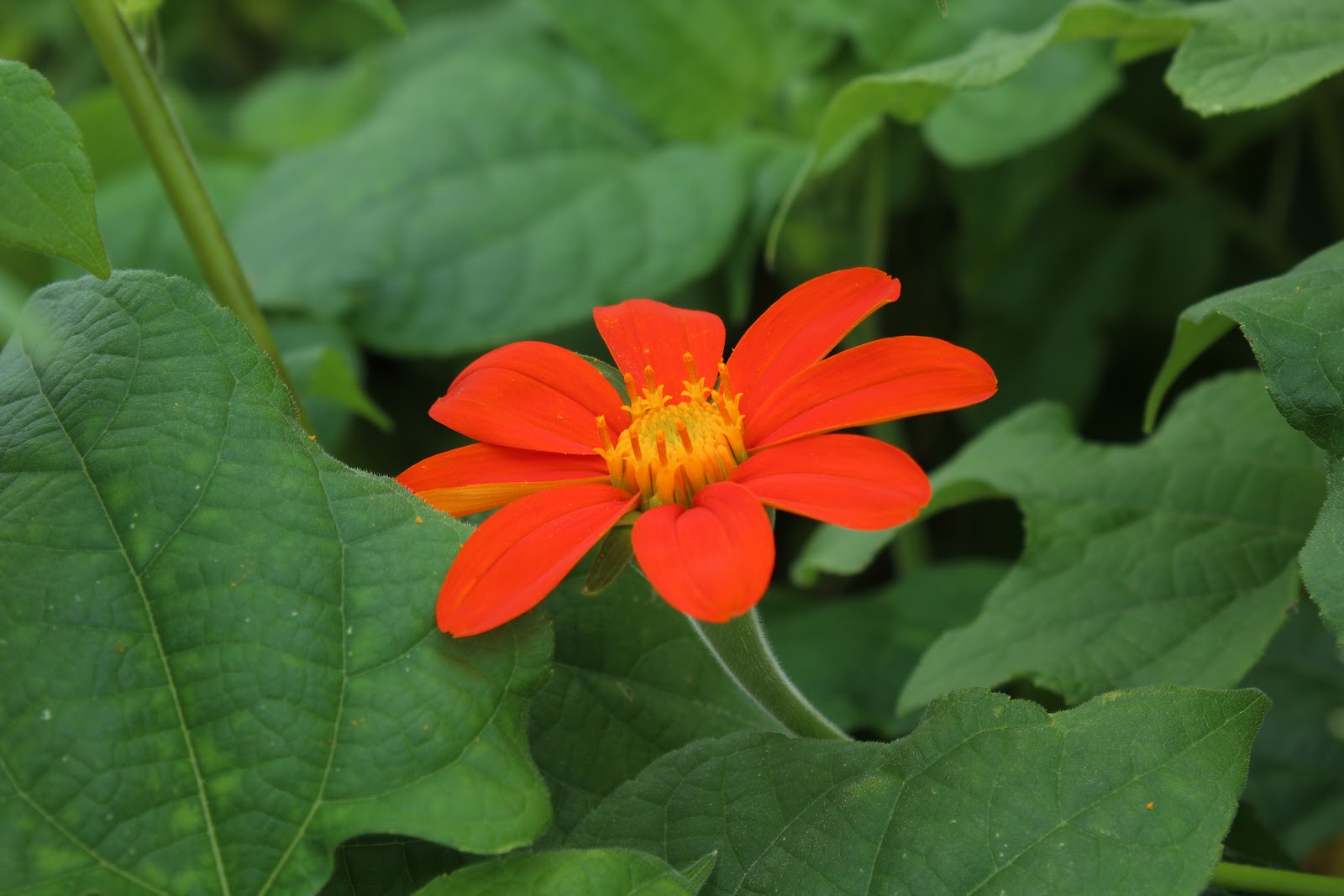
Tithonia, also known as Mexican sunflower

There is much that is still unknown about the way soil functions naturally and how we can build a functioning soil ecosystem that grows nutritious organic vegetables.  And the truth is that not all organic farmers are good farmers; some of us, while well-intentioned, are still learning -- farming, after all, is an art as much as a science, and organic farming takes years of practice to learn well.  A wise, experienced conventional farmer may well grow food with more nutritional value than a sloppy, inexperienced, or negligent organic farmer.  A master farmer -- of any stripe -- is one who grows bountiful yields of highly nutritious vegetables from highly functioning soil; I just happen to believe that organic methods are the road I want to take to get to that level, if I ever do.

Farm-to-plate: a late summer meal made from Waltham Fields' vegetables

There are very few things that I'm willing to say I believe in as I get older.  Even the Red Sox are not what they used to be.  And 'big organic'  is definitely not what 'organic' used to be.  For better or for worse, organic farming has come a long way from the  days of back-to-the-landers with their bug-riddled zucchini and kale.  But the fundamental idea of trying to grow healthy food -- and lots of it --  in a way that is kinder to the earth and to those who work it is one that I do believe in and try to manifest every day.  Making that food available to everyone in our society is another idea I believe in.  And I am truly grateful that, day in and day out, I can practice something that I deeply believe, regardless of the study of the day or the food fad of the week.  That's why we grow organically at Waltham Fields.


Hope you enjoy the harvest,

Amanda, for the farm crew

Images by Rebekah Carter (2012).

Friday, December 16, 2011

Notes from the Learning Garden: More Than Flowers

This time of year more than any other I find myself most nights working on some craft or another (mostly knitting) getting ready for the holidays. Though I love the anticipation of color choices and design graphing, and the soothing motion of the knitting itself, my co-workers and family can attest to the fact that I always feel the need to share my project ideas and progress in great detail (and excited tones) as if the doing itself is not quite enough: as if the project will only come to life when shared with others.

This is why one of mo
st wonderful things I can think of to do this time of year is to find a great group of people and spend an evening crafting together, which is exactly what we did at the felted flower workshop this past Thursday evening. There, the ideas, the progress, and the sharing all happened at once as each of the eight participants imagined and created a lovely flower from scraps of colorful wool fiber. And what amazing results! Even as I go back to my knitting basket to plug away at holiday gifts I am filled with inspiration from the creativity and warmth expressed in the workshop and I feel ready for the passing of another year and the promise of many new projects to come.

Happy holidays everyone!


Jericho

Wednesday, May 18, 2011

Eat-Your-Weeds Salad


With the new growth comes the old in the typical kitchen garden. Unless you're meticulous, chances are you have some overwintered crops thriving in various spots of your garden plot. Put those weeds and any early-harvest crops to use in a freshly-cut salad. From the gardens I maintain both on and off the farm, I gathered the following to make a tasty salad, almost entirely from overwintered crops:
  • mustard flowers
  • violets
  • chives
  • kale
  • red and green-leaf lettuces
  • radish tops (just harvested from a school garden... the kids ate all of the radishes!)
Creamy Sesame Dressing
(makes approximately a 1/4 cup)

Ingredients:
  • 3 tsp tahini (can substitute peanut butter if you don't have tahini)
  • 2 tbsp vinegar (apple cider or rice wine)
  • 1 tsp sugar (agave nectar or honey work well)
  • 2 tbsp sesame oil
  • dash white pepper
  • salt or soy sauce to taste
Directions:

In a bowl, whisk together all ingredients except the oil. Slowly drizzle the oil into the mixture as you simultaneously whisk to thoroughly combine. Serve immediately. Double or quadruple the measurements for 1/2 or 1 cup of dressing, respectively.

My Two Cents:

These measurements make for a slightly-sweet and tangy dressing. If you like less tang and more sweet, use less vinegar and add more sugar and sesame oil. For even more flavor, consider adding a touch of minced or grated garlic, ginger, or orange peel. For a little extra crunch and nutrition, toss in some toasted sesame seeds; to make them, constantly stir raw seeds in a small skillet over low heat until they begin to turn golden brown.

Rebekah


Images and dressing recipe by Rebekah Carter (2011).

Monday, September 6, 2010

Pollinators and Flowers

A monarch butterfly on a purple coneflower
(Echinacea purpurea)


Pollination is the transfer of pollen from an anther to a stigma of the same or another flower or from a male cone to a female cone in coniferous plants. Successful pollination leads to fertilization, which in turn leads to the production of a plant's fruit and seeds. Pollination may be performed by insects, birds, bats, wind, and humans. Here are some pollinators and flowers we spotted at the farm this summer.

Unknown flowers at GROW (above)

Cosmos with a bee (above)

A sunflower with a bee (above)

Marigolds and a big bee (above)

A female Eastern Black Swallowtail landing on a zinnia (above)

Media (text and image) created and published by Rebekah Carter 2010.